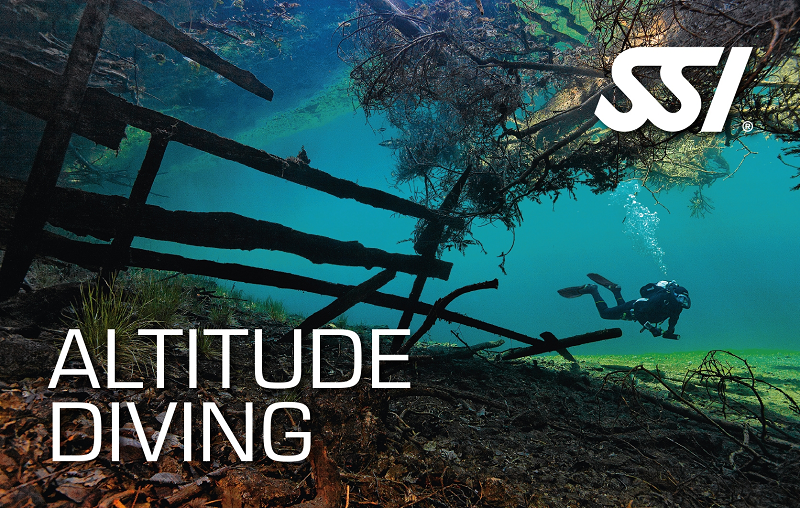
The SSI Altitude Diving specialty program provides the knowledge and skills necessary to safely plan and execute dives at altitudes higher than 300 meters (1,000 feet) above sea level.
Because atmospheric pressure is lower at higher elevations, standard sea-level dive tables and decompression models do not apply. This course ensures you can adjust your equipment and planning to prevent decompression sickness.
📘 Course Core Objectives
The program focuses on the physiological and physical changes that occur when diving in mountain lakes or high-altitude reservoirs.
Pressure Changes: Understanding how reduced surface pressure affects nitrogen absorption and release.
Planning & Tables: Learning to use altitude adjustment tables or specific altitude settings on a dive computer.
Safety Stops: Adjusting ascent rates and safety stop depths for the specific environment.
Equipment: Preparing gear for colder water temperatures often found at high altitudes.
✅ What You Will Learn?
Altitude Theory: The physics of diving in a lower-pressure environment.
Depth Conversions: How to calculate “Theoretical Ocean Depth” to ensure you stay within safe limits.
Travel Planning: Managing the “flying after diving” risks, which are more complex when returning from a high-altitude site to sea level.
Environmental Awareness: Dealing with limited visibility or thermal layers (thermoclines) common in mountain lakes.
🎓 Course Requirements
Minimum Age: 10 years old.
Prerequisites: Must be a certified Open Water Diver (or have an equivalent certification from another agency).
Training Sessions:
One academic/theory session.
Minimum of two open water dives are typically required to earn the certification.
Maximum Depth: Determined by your current certification level (e.g., 18m for Open Water, 30m for Advanced Adventurer).
✅ Why Take This Course?
If you plan to dive in inland lakes—such as those in the Alps, the Rockies, or even certain high-elevation quarries—this certification is essential. Most dive centers located near high-altitude water bodies will require this specialty (or proof of experience) before allowing you to dive.